Before you throw it out, make the right call.
Forty-five blunt repair entries for rusty tools, stuck screws, marked tabletops, loose hardware, tired finishes, brass, veneer, leather, and wood that only looks finished.
or see what's inside first
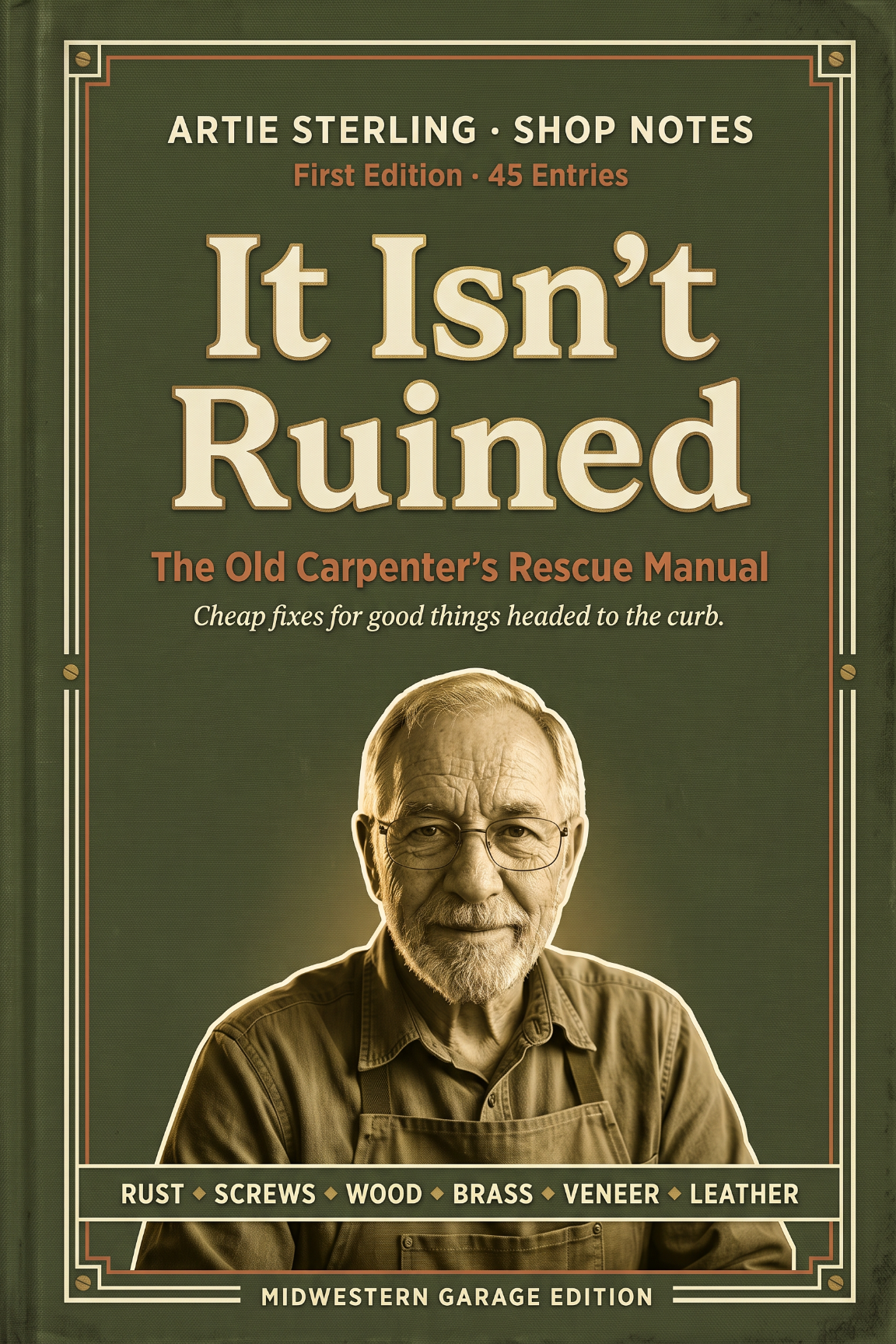
Ugly is not the same as ruined.
A lot of good things get hauled to the curb because the first look is loud: orange rust, black rings, white haze, green battery fuzz, a screw head chewed smooth.
Here is the expensive mistake: you see damage on the surface and assume the part is gone all the way through. Sometimes it is. Often it is not. A cast iron table saw top with orange bloom may need oil and foil, not a grinder. A hinge screw that spins usually means crushed wood fibers, not a dead door. A white ring is often trapped moisture in the film, not ruined wood.
The opposite mistake costs just as much: stubbornly "saving" a thing that has crossed the line. Rotten wood is not a cleaning job. Cracked cookware is not a seasoning problem. Plating that has flaked off is not coming back with vinegar.
It Isn't Ruined is built around that dividing line. Look closely. Test simply. Fix cheaply when the material is still sound. Stop when the honest answer is replacement.
Look. Try. Stop.
Every entry runs the same bench rule — the way I taught shop for thirty years.
Look
Find out if the damage is dirt, finish, corrosion, compression, or missing material.
Try
Start with the lowest-risk fix that matches the material.
Stop
Quit when safety, structure, or the material says the repair is done.
Specific fixes, not cheerful guessing.
Each entry starts with the cause, then the repair order, then the point where the cheap fix should lose.
- 01Tell surface rust from lost metalbefore you sand away good iron on a saw top, drill press table, skillet, chisel, plane, or square.
- 02Clean a dragging handsaw platewith mineral spirits, wax, and a flat backer before blaming the teeth.
- 03Know vinegar's limits on old hardwareand why baking-soda neutralizing and oil afterward are not optional details.
- 04Get a stuck clamp movingwith sun heat, wax, and patient back-and-forth motion instead of bending the handle.
- 05Clean green battery fuzz safelywith gloves, eye protection, vinegar on a cotton swab, and a dry contact check.
- 06Separate rust, ice, and grit in a frozen padlockso you thaw, clean, and lubricate in the right order.
- 07Rescue cammed-out and rounded screw headsby cleaning the recess, seating the right driver, adding grip, and quitting before drilling is your only option.
- 08Free painted-over screws without tearing trimwhile treating old paint as a hazard until you know better.
- 09Fix hinge screws that spinwith toothpicks or golf tees, grain direction, glue, and the right longer screw when framing is the answer.
- 10Lift dents with unbroken fibersusing damp cloth and iron steam while avoiding finishes that blush or soften.
- 11Reduce white heat rings and light scratchesby changing moisture and light reflection instead of stripping the whole top first.
- 12Stop at the right timewhen wood is rotten, plastic is brittle, cookware is cracked, plating is gone, or solvent risk is not worth it.

Artie Sterling, retired shop teacher
I am seventy-five. I spent ten years as a finish carpenter, then thirty years teaching high school shop in a small Midwestern town. I do not believe every old thing is precious. I do believe a surprising number of fixes are already sitting in your kitchen drawer.
“If a repair needs a miracle, I say so. If it needs a pencil, wax, vinegar, foil, a golf tee, or patience, I say that too.”
Get the bench copy today.
- 255-page PDF — 45 practical repair entries across 46 chapters
- Rust, screws, wood surfaces, brass, veneer, leather, hardware, and finishes
- Safety limits for rot, cracks, lead hazards, failed plating, brittle plastic, and solvents
- Read on any device, or print the pages you want beside the bench
- Free lifetime updates to this edition
- 7-day refund if it is not useful to you
Use it for a week. Keep it only if it earns the hook on the pegboard.
If the book is not useful to you, ask for a refund within 7 days. No drama. A manual that does not help does not belong on your bench.
Plain answers before you buy.
Is this for total beginners?
Yes, if you can slow down and follow an order. The entries explain what is happening before they tell you what to rub, soak, tighten, loosen, plug, or stop doing.
Does it require a full shop?
No. Many entries start with household materials: foil, oil, baking soda, vinegar, cotton swabs, pencil graphite, wax, toothpicks, golf tees, rubber bands, salt, and a proper driver. Some fixes need basic hand tools. When a job belongs beyond that, the manual says so.
Will it make unsafe things safe?
No. Cracked cookware, rotten wood, bad handles, missing material, failed plating, lead hazards, and solvent risks are called out. The point is to save good things headed to the curb, not to talk you into stubbornness.
Is this about antique restoration?
Not in the museum sense. It is about practical rescue: tools that work, furniture that can be used, hardware that can be trusted, and finishes that can be improved without making a bigger mess.
Can I print it?
Yes. It is a PDF. Read it on a device or print the pages you need beside the bench. A printed entry next to the work is often better than trying to remember three steps while holding a wrench.
What happens after I buy?
You get instant PDF access after purchase. Future updates to this edition are included free for life. If it is not useful to you, you have a 7-day refund window.
You want showroom refinishing, power-tool heroics, chemical shortcuts without warnings, or permission to keep using cracked, rotten, brittle, or unsafe material. This is a practical rescue manual, not a dare.
The next curb pile can wait ten minutes.
Before you throw out the rusty clamp, the brown brass pull, the dragging saw, the marked tabletop, or the door with the spinning hinge screw — check the failure. It may be a small problem sitting near the surface.
Get It Isn't Ruined — $19.99Instant PDF · 7-day refund · free lifetime updates